Do Germany’s top universities dominate faculty hiring because of their reputation, or because they simply produce more doctoral graduates?
This is the central question we address in our new MAGKS Discussion Paper „Is the dominance of graduates from top-tier universities among tenured faculty driven by prestige or output?“. The study was conducted by Stefan Buechele, Guido Buenstorf, Matthias Hügel, Johannes König, and Maria Theissen. Based on a unique dataset covering the entire population of doctoral graduates in Germany from 1961 to 2015, we investigate whether the university where someone earned their PhD influences their chance of becoming a professor, or whether it is mainly a question of numbers.
Recent studies from the United States have shown that faculty hiring is highly concentrated. A small group of elite universities trains a large share of all professors. We find a similar pattern in Germany. Just five universities account for almost 18 percent of all professorship appointments between 1961 and 2015. Eleven universities, all members of the prestigious U15 alliance, account for nearly 40 percent.
Figure 2: Where professors earned their doctorates

At first glance, this might suggest that university prestige plays a major role in faculty hiring. But there is an alternative explanation. These same universities also produce the highest number of doctoral graduates. This could mean that their dominance reflects supply rather than favoritism.
Our analysis shows that the universities producing the most professors are also those producing the most PhDs. This is not a coincidence. It strongly suggests that the hiring concentration is mainly driven by differences in output.
Figure 3: Where doctoral graduates earned their degrees
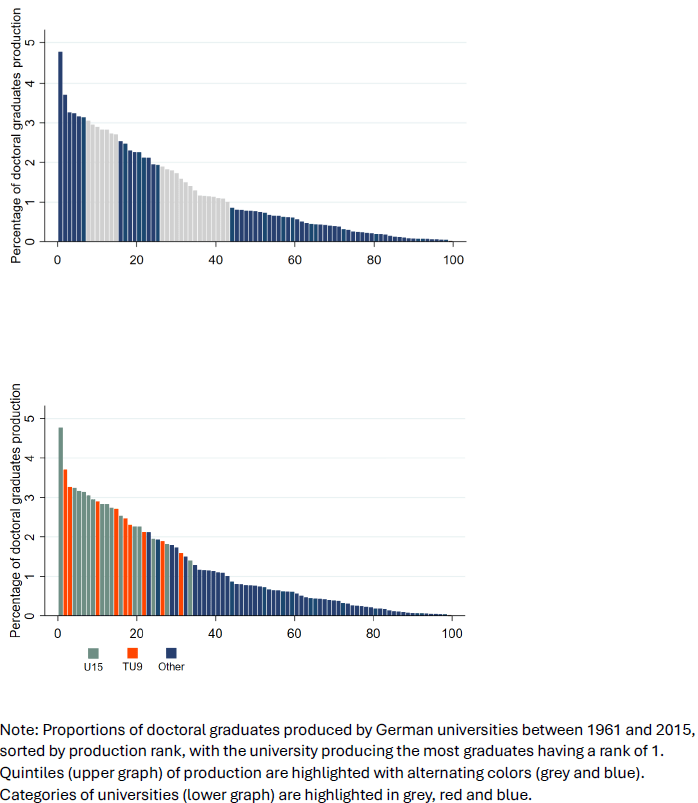
Once we control for factors such as academic discipline, gender, and signals of academic ambition, we find no consistent advantage for graduates from more prestigious universities. In other words, holding a doctorate from a U15 or TU9 university does not substantially improve a person’s odds of becoming a professor. Despite rising competition and initiatives to promote elite universities, we do not observe an increasing role for prestige in hiring decisions. On the contrary, differences between university types have actually decreased for more recent cohorts.
Main Takeaways
- Faculty hiring in Germany is highly concentrated, but this closely mirrors where doctoral degrees are awarded.
- We find no systematic advantage in hiring chances for graduates from top-tier universities.
- The patterns we observe are more consistent with output-based explanations than with social closure or reputational advantages.
- Even as academic competition has intensified, hiring appears to remain based more on merit and supply than on institutional status.
These findings are important for understanding academic career opportunities and for assessing whether elite universities are privileged in hiring. They also call for caution when interpreting concentration in hiring as evidence of social closure.
You can read the full paper here:
https://www.uni-marburg.de/en/fb02/research-groups/economics/macroeconomics/research/magks-joint-discussion-papers-in-economics/papers/2025-papers/16-2025.pdf
 Dr. Johannes König